Come share your thoughts about everything..don't feel shy because your thought today may be tomorrow's lifestyle......
Friday, August 13, 2010
Everybody who is concern.... Will we learn something and take some action?
Floods across Asia see death and disease afflict largest continent
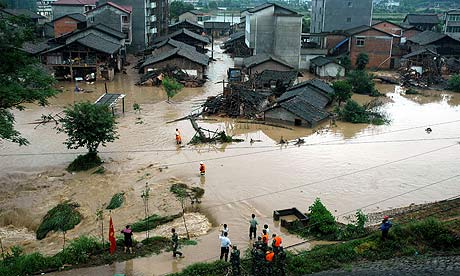
China devastated by floods
Roads and houses in Shayuan village aresubmerged after floods hit south-east China's Jiangxi province
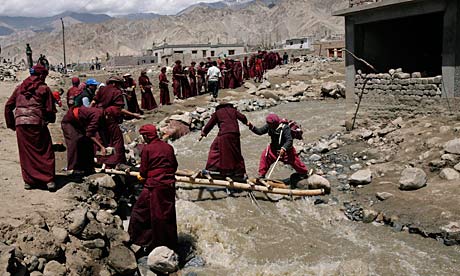
Cloudburst flattened the Leh
Monks conduct a rescue operation after flash floods at Choklansar, on the outskirts of Leh
Floods In Pakistan Kill at Least 800
Pakistanis on Saturday crossed a main highway damaged by a flood in Charsadda, in northwestern Pakistan, near the border with Afghanistan
Floods
devastateNorth Korea
State media reported that thousands of residents have lost their homes and farms
In China, the death toll rose to 702 after Sunday's landslides in Gansu the deadliest incident so far in the country's worst flooding in a decade. A debris-blocked swollen river burst, swamping entire mountain villages in the county seat of Zhouqu and ripping homes from their foundations.
More than 1,450 people had been killed by floods and landslides in China and caused tens of billions of dollars in damage across 28 provinces and regions. as of Aug. 6, according to the Ministry of Civil Affairs.
In Pakistan, thousands of people fled the central city of Muzaffargarh as authorities warned swollen rivers could soon submerge the area, adding to the worst natural disaster in the nation's history,two weeks of flooding have killed 1,500. The United Nations said the government's estimate of 13.8 million people affected by the country's worst-ever floods exceeded the combined total of three recent disasters – the 2004 Indian Ocean tsunami, the 2005 Kashmir earthquake and the 2010 Haiti earthquake.Rescue workers have been unable to reach up to 600,000 people marooned in the north-western Swat valley, where many residents were still trying to recover from an intense battle between the army and the Taliban last spring. At least 165 people were killed and another 370 injured when flash floods triggered by torrential rains struck this Himalayan town in Leh in Ladakh region, northeast of Jammu and Kashmir, leaving a trail of death and destruction.While many villages like Sabu, Phyang, Nimoo and Choglamsar were affected, the city bore the maximum brunt of the calamity.
Thousands of army and paramilitary soldiers continued clearing roads and removing the debris of hundreds of homes flattened in the Ladakh region by Friday's thunderstorms.
In North Korea, some 10,000 people sheltered in public buildings in the border city of Sinuiju near China because of flooding, the Red Cross said. Flash floods destroyed thousands of homes across the impoverished country, and the Amnok river recorded its highest water level in 15 years. Human activity that changes the surface of the Earth also effects the water cycle, and can cause floods. Buildings, parking lots and roads, replace grass and dirt with concrete. Under normal circumstances, soil acts like a sponge and soaks up a fair portion of rainwater. But in crowded towns and cities, rainwater flows into storm sewers and drainage ditches, and, at times, overloads them. An urban area can be flooded by an amount of rainfall that would have had no impact in a rural area. The destruction of the nation's wetlands may also contribute to moderate floods. The wetlands are the swampy land along the edges of some rivers. When it rains, the wet soil and mud of a wetland acts like a sponge and stores the extra water. But much of America's wetlands have been drained for farmland or to build houses. The only place flood water can go is up and over its normal riverbanks and into areas where it can cause major damage. Floods are primarily natural events. Human activity influences the frequency and severity of floods, but they are created by Mother Nature. There is no really workable protection against major floods like those that hit Grand Forks in the spring of 1997 and the MississippiRiver Basin in 1993. Our best defense against floods is an understanding of the way people treat their environment and better weather prediction.
 Monks conduct a rescue operation after flash floods at Choklansar, on the outskirts of Leh

No comments:
Post a Comment